
Custom bars and wine cellars are replacing the traditional dining room in affluent Orinda and Danville homes. Affluent homeowners across the East Bay are investing in custom entertaining spaces that combine luxury wet bars with temperature-controlled wine storage. Creating the ultimate hosting environment for their lifestyle.
Schedule a consultation to explore your custom design-build options.
A premium home bar wine cellar design Bay Area project blends high-end hosting with precise climate control to preserve fine vintages. This design-build approach brings structural foundation work, custom wood cabinetry, and specialized cooling systems under a single team, ideal for Orinda, Danville, Lafayette, and Walnut Creek luxury estates.
How do you start building a custom hosting and storage space that fits both your entertaining style and your East Bay property? The answer depends on your space, budget, and collection size, but every successful project begins with a clear plan.
How Do You Plan a Home Bar Wine Cellar Design in the Bay Area?
Planning a home bar wine cellar design Bay Area project starts with assessing your space, local building codes, and cooling needs. Working with a full-service design-build contractor ensures the layout, plumbing, structural engineering, and custom cabinetry are coordinated under one contract, saving time and reducing costly coordination errors.
At-home bars and wine cellars are among the most popular luxury additions in East Bay remodels. Homeowners in Orinda and Danville increasingly want dedicated spaces that store their collections and serve as natural entertaining hubs. A custom cellar protects your investment in fine vintages while adding a visually stunning focal point to your home.
This addition requires careful layout and utility planning. A functional bar needs plumbing, electrical, and custom cabinetry. Working with a full-service design-build contractor ensures seamless execution across all trades.
Luxury Trends in East Bay Homes
In towns like Lafayette and Walnut Creek, custom hosting zones are in high demand. According to industry reports from Millesime Modern Cellars, custom wine storage is now a top trend in high-end projects, creating spaces that showcase collections while giving guests a cozy spot to gather. Many luxury homes feature open floor plans that can accommodate a wet bar or walk-in glass cellar adjacent to the great room. Allowing smooth transitions when hosting dinner parties.
Specialized Engineering for Hillside Properties
Building a cellar or bar in the East Bay hills requires deep structural expertise due to steep slopes and complex soils. Data from the U.S. Geological Survey (USGS) shows that these hilly zones present significant challenges for foundation engineering, especially for deep cellar builds. If you plan to dig a cellar on a sloped lot, you need skilled design-build services to keep your home structurally safe.
Our team handles foundation work and custom styling for design-build room additions. When excavating into a hillside, proper water control and drainage are essential since clay-heavy soils retain moisture. A robust vapor barrier and reinforced foundation footings prevent moisture intrusion into your wine storage area. A design-build firm manages these technical steps, eliminating the need to coordinate separate engineers, excavators, and finish contractors.
3D Design Visualization for Custom Cellars
Before construction begins, you need to see exactly how the space will function. Golden Heights Remodeling uses detailed 3D design plans, which you can explore in our 3D design portfolio. You can examine how custom racks, cooling units, and bar seating fit within your floor plan, preventing costly layout mistakes and ensuring the finished product matches your expectations.
Where Should You Build Your Custom Home Bar and Wine Cellar?
The ideal location for your custom bar and cellar balances accessibility with climate requirements. Basements offer natural insulation and stable temperatures, while main-level glass-walled cellars create dramatic visual impact. The best choice depends on your floor plan, entertaining habits, and the structural realities of your East Bay property.
Basement vs. Main-Level Entertaining Hubs
For many East Bay homeowners, the basement is the natural choice for a wine cellar. Below-grade spaces offer cooler, more stable temperatures and naturally higher humidity, reducing the workload on active cooling systems. However, modern luxury layouts frequently position custom cellars on the main living level to maximize visual impact and daily accessibility.
Main-level walk-in cellars, often featuring floor-to-ceiling glass walls, act as stunning architectural focal points. Placing a custom bar adjacent to the cellar allows you to serve guests seamlessly during gatherings. This open-plan layout is popular in estate designs in Danville and Orinda, where living areas often open directly onto outdoor patios and terraces.
Structural Engineering for Hilly East Bay Terrain
If you are building below-grade or as a room addition in hilly areas like the Berkeley hills or Oakland hills, structural engineering is paramount. Data from the U.S. Geological Survey (USGS) confirms that these regions present unique foundation challenges due to steep slopes and expansive clay soils. Ground movement and high lateral soil pressure require heavily reinforced retaining walls and specialized waterproofing systems for basement cellars.
Working with a professional design-build firm provides a massive advantage. A single-source team handles the complex structural engineering alongside high-end cosmetic design, ensuring that excavation. Foundation underpinning, vapor barrier installation, and finish work are coordinated perfectly under one contract. Learn more by visiting our custom home building services page.
Maximizing Your Investment: Retrofit vs. New Construction
While new construction allows complete layout freedom, retrofitting a bar or cellar into an existing home is highly feasible and can increase property value significantly. In the Bay Area’s competitive real estate market, premium amenities help homes in the $1.5M to $5M+ price range stand out. Industry data suggests that a custom wet bar and wine cellar addition typically recoups fifty to eighty percent of its cost at resale when built with high-end materials and placed near primary entertaining areas.
What Materials Work Best for a Luxury Home Bar and Wine Cellar?
Selecting materials for a custom home bar wine cellar design Bay Area project means balancing beauty with durability. Quartzite and engineered quartz resist wine stains and moisture on countertops, while dense hardwoods like White Oak. Walnut, and Sapele Mahogany hold up to the humidity fluctuations of a wine cellar environment.
Choosing the right materials is critical for any custom luxury home remodeling project. Every surface must offer both beauty and durability, especially when designed for storing fine vintages and hosting guests regularly.
High-Performance Countertops and Backsplashes
Countertops must withstand spills, moisture, and heavy use. Quartzite offers natural stone beauty with high resistance to citrus and wine stains. Engineered quartz provides a highly uniform, stain-proof alternative at $60 to $150 per square foot installed. Marble offers classic veining but is porous and prone to etching from acidic spills. Butcher block adds natural warmth but requires regular sealing and maintenance. For backsplashes, mirror panels are popular in smaller bar areas because they reflect light and make the room feel more spacious.
Cabinetry Styles and Price Points
Custom cabinetry anchors the room and houses your collection. Stock cabinets start around $1,500 but offer limited sizing and finish options. Semi-custom cabinets range from $3,000 to $7,000, while fully custom cabinetry often reaches $15,000 or more. Custom builds are tailored to your exact layout, easily incorporating specialized features like pull-out liquor drawers, built-in stemware racks, and under-cabinet lighting. When planning a home bar wine cellar design Bay Area project, homeowners frequently request soft-close drawer glides, integrated LED strip lighting, and dedicated spirit display shelving.
Premium Wood Species and Protective Seals
For wine racks, select wood species that naturally resist decay and perform well in humid environments. According to Millesime Modern Cellars, premium materials like White Oak, Walnut, and Sapele Mahogany are the gold standard for custom wine cellar construction. These dense hardwoods resist warping, hold up over decades of use, and do not off-gas compounds that can taint wine through the cork.
To protect your collection, maintain consistent temperature and humidity levels using a properly sized cooling system. Sealing the cellar with vapor-proof products like closed-cell spray foam insulation and a dedicated vapor barrier is essential. This protects your wine from outdoor humidity fluctuations and temperature swings that can accelerate aging or spoil bottles.
Passive vs. Climate-Controlled Wine Cellars: Which Is Right for You?
Choosing between a passive and climate-controlled wine cellar depends on your location, collection size, and budget. Passive cellars rely on underground conditions and cost $10,000 to $30,000, but cannot maintain consistent temperatures during hot East Bay summers. Climate-controlled cellars use mechanical cooling for precise temperature and humidity management, typically costing $15,000 to $100,000 or more.
Natural Climate: Passive Wine Cellar Design
Passive cellars rely on natural underground conditions. Built below grade, typically in a basement, they keep wine cool using the surrounding soil’s stable temperature without mechanical cooling. A passive cellar typically costs between $10,000 and $30,000, saving on ongoing electrical costs compared to active systems.
However, passive rooms can struggle during hot summer months in East Bay towns like Orinda or Walnut Creek. Where seasonal temperatures can push a basement into the upper 60s and low 70s. For long-term aging, you must keep the space dark and still, since natural airflow provides limited climate uniformity. If you need to expand your storage capacity, our design-build room additions can create a dedicated cellar zone.
| Feature | Passive Cellar | Climate-Controlled Cellar |
|---|---|---|
| Average Cost | $10,000 to $30,000 | $15,000 to $100,000+ |
| Cooling Method | Natural ground air | Mechanical cooling unit |
| Best Location | Cool basements | Anywhere in the home |
| Temperature Control | Passive, follows ground temp | Precise, digitally controlled |
| Humidity Control | Matches ambient soil moisture | Built-in regulator (50-70%) |
Active Systems: Climate-Controlled Mechanical Cooling
Active cellars use specialized cooling units to manage the internal environment continuously, keeping the room at a steady 55 degrees Fahrenheit and 60 percent relative humidity. Active cellars range from $15,000 to $100,000 or more depending on room size, system type, and finish level.
Sealing the room properly is vital to protect your bottles. Professional-grade vapor barriers and closed-cell insulation prevent outside moisture and temperature from affecting your cellar. Three main types of cooling systems are available:
- Through-wall units: Budget-friendly option, $1,600 to $3,000, suitable for small to medium cellars.
- Split systems: Quiet and efficient, $2,500 to $5,000, with the compressor located outside the cellar for silent operation.
- Ducted systems: Premium seamless integration, $4,000 to $8,000, keeping all mechanical noise and heat rejection outside the wine room entirely.
Racking Systems and Capacity Planning
Plan your cellar for your current collection plus room to grow. Most serious collectors require space for 500 to 1,000 bottles. Redwood and Sapele Mahogany resist rot and perform well in humid environments. Metal racks offer a modern aesthetic and make bottle labels easy to read without pulling bottles. A design-build firm will help you calculate proper spacing to allow cool air to circulate around each bottle, preventing hot spots that can accelerate aging unevenly.
Wet Bar Design: Sinks, Refrigeration, and Functionality
A wet bar includes a dedicated sink with running water, creating an independent beverage station that eliminates trips to the kitchen. For luxury East Bay homes in Lafayette and Walnut Creek, a fully equipped wet bar with dual-zone wine coolers. Beverage centers, and clear ice makers is the standard for sophisticated entertaining.
Is a Wet Bar Sink Necessary for Your Entertaining Style?
A sink eliminates constant trips to the kitchen to wash glassware, dump melted ice, or rinse garnishes. Position the sink along the back bar to maximize usable prep workspace. Under-mount stainless steel, copper, or dark composite sinks paired with a high-arc gooseneck faucet are the top choices for custom bars. Letting you easily rinse stemware and fill tall pitchers without awkward maneuvering.
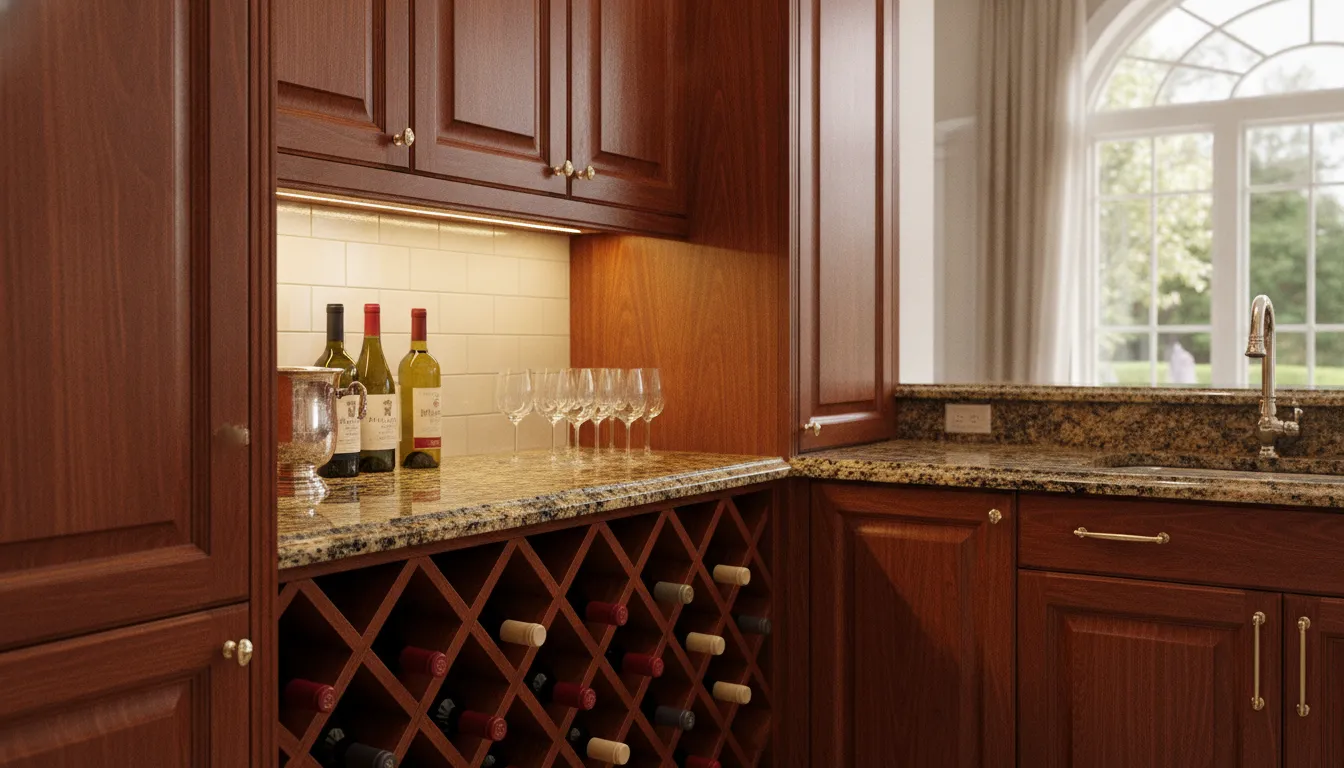
Integrating Premium Appliances and Refrigeration
High-end refrigeration is the backbone of any luxury home bar. True built-in undercounter units are engineered to vent from the front, allowing them to fit flush against custom cabinetry without overheating. Freestanding units adapted for built-in use often fail prematurely due to inadequate ventilation, so choose purpose-built appliances from the start.
For a complete entertaining setup, consider incorporating these specialized appliance zones:
- Dual-Zone Wine Cooler: Maintains separate temperatures for reds (55 to 65 degrees Fahrenheit) and whites (45 to 50 degrees Fahrenheit).
- Beverage Center: Keeps sodas, mixers, and beers ice-cold at 33 to 38 degrees Fahrenheit.
- Clear Ice Maker: Produces dense, slow-melting ice spheres or cubes that dilute drinks more slowly than standard crescent ice.
These appliances require dedicated electrical circuits to prevent tripped breakers when multiple compressors cycle on simultaneously during a party.
Bay Area Cost Breakdown and Permits
Bay Area wet bar projects typically range from $15,000 to $45,000, with high-end custom builds exceeding $60,000. Primary cost drivers include:
- Plumbing installation: Connecting supply and drain lines, typically $2,000 to $4,000.
- Electrical work: Adding dedicated circuits, roughly $800 to $1,500.
- Custom cabinetry: Fully custom cabinets from $15,000+; semi-custom options from $5,000 to $10,000.
- Building permits: Local permit fees in Danville, Walnut Creek, Lafayette, and Orinda typically cost $500 to $2,000.
A professional design-build contractor manages all permit submissions, inspections, and trade coordination. If you are exploring a broader luxury remodel, find helpful planning advice in our kitchen renovation guide.
Step-by-Step Guide to Lighting and Finishing Touches
Transforming a wet bar and wine cellar into a luxury entertaining destination relies on lighting layering, seating optimization, and premium finishes. Follow this step-by-step approach to create a sophisticated space that impresses guests and protects your wine investment.
-
Design a Layered Lighting Scheme
Layered lighting is essential for creating the right mood. Combine three types of illumination:
- Ambient Lighting: Recessed ceiling lights on dimmers provide adjustable overall illumination for the room.
- Task Lighting: Under-cabinet LED strips illuminate countertops for mixing drinks and preparing garnishes.
- Accent Lighting: Low-voltage LED backlighting inside glass-front cabinets creates a premium jewelry-box effect for your glassware and spirits.
For wine storage zones, use only low-heat, UV-free LED fixtures to prevent heat degradation and light-strike damage to your wines over time.
-
Optimize Bar Seating and Layout Flow
Bar seating transforms a prep zone into a social hub. Standard 42-inch counters pair with 30-inch bar stools. Allow at least 24 inches of width per seat for comfortable elbow room, and ensure a countertop overhang of at least 12 inches for adequate legroom.
-
Incorporate Glass-Front Cabinets and Stemware Racks
Glass cabinet doors protect barware from dust while displaying it beautifully. Standard 12-inch-deep upper cabinets fit most cocktail glasses, while 15-inch-deep cabinets are recommended for oversized wine stems. Under-cabinet stemware racks suspend wine glasses by their bases, keeping them within easy reach while freeing up counter space.
-
Use Backsplashes and Flooring to Define the Entertaining Zone
An 18-to-24-inch-high backsplash protects walls from splashes and serves as a design canvas. Consider a single slab of quartzite that matches your countertop, or install a mirrored backsplash to make a tight bar area feel more spacious. Flooring transitions help define the entertaining zone visually. Transitioning from main-level hardwood to durable tile or stone around the bar area makes cleanup easy and signals a distinct functional zone.
Frequently Asked Questions
How much does a home bar and wine cellar design in the Bay Area cost?
A standard wet bar typically costs between $8,000 and $35,000, while high-end designs can exceed $60,000. For wine storage, passive cellars range from $10,000 to $30,000. Active climate-controlled cellars cost from $15,000 to more than $100,000. Custom cabinetry adds $3,000 to $15,000, and local building permits typically add $500 to $2,000 depending on your city.
What materials are best for a home bar and wine cellar design in the Bay Area?
For wine racks, use dense hardwoods that resist moisture and decay. According to Millesime Modern Cellars, top choices include White Oak, Walnut, and Sapele Mahogany. All wood surfaces must be sealed with a vapor-safe finish. For bar countertops, choose quartzite or engineered quartz, which resist wine stains far better than soft marble.
Can you build a basement wine cellar in the East Bay hills?
Yes, but steep slopes and clay soils require extra planning. Data from the U.S. Geological Survey confirms that the Berkeley and Oakland hills present foundation engineering challenges. Proper waterproofing, drainage, and reinforced retaining walls are essential. A skilled design-build firm handles both the structural engineering and the cellar finish work.
How does 3D design help when building a luxury home bar?
Designing a custom home bar or wine room involves many interdependent details. According to Golden Heights Remodeling, 3D design visualization lets you preview your layout, cabinetry, and lighting before construction begins. Seeing a realistic digital model of your space helps you make changes early, preventing costly mid-construction revisions.
Bring Your Home Bar and Wine Cellar Vision to Life
A custom home bar and wine cellar is a lasting investment in your lifestyle, your collection, and your home’s value. From the technical challenges of foundation engineering in the East Bay hills to the high-end finishing touches of custom walnut cabinetry and quartzite countertops. Golden Heights Remodeling manages every detail of your design-build project with precision and craftsmanship.
Schedule a free consultation with Golden Heights Remodeling to start designing your dream entertaining space. Explore our 3D design portfolio to see custom additions we have created in Orinda, Danville, Lafayette, and across the Bay Area.
Ready to talk about your kitchen?
Get a free, no-pressure design consultation. We'll walk through your goals, budget, and the upgrades with the best return for your home.